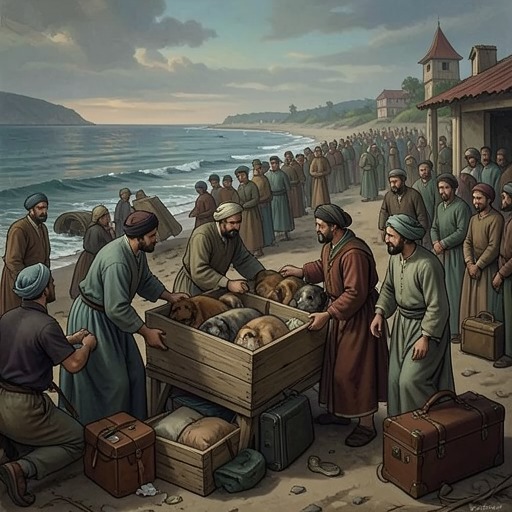
The Pondicherry Zoo Animals Are Sold and Relocated
Life of PiThe sale and relocation of the Pondicherry Zoo animals was the practical counterpart to the Patel family’s decision to leave India for Canada. It was at once a way to finance a new beginning and a vast logistical undertaking: a zoo’s living collection had to be valued, matched with buyers, medically cleared, documented, and transported across borders. The episode makes migration larger than a family’s change of address. Animals, institutions, money, and regulation all had to move through the same uncertain transition.
Causes and Background
The family’s departure followed mounting political and economic anxiety. In the mid-1970s, the Indian Emergency and the dismissal of the Government of Tamil Nadu deepened Pi’s father’s fears about the country’s direction. The family’s zoo was a cultural and educational institution, not a reliably profitable business, and its prospects depended on political stability and the rule of law. Pi understood the decision as a response to the sense that work and security could be undone, and that a better future might exist elsewhere. His parents decided that the family would leave; the news astonished Pi and Ravi, for whom Canada was a distant and largely unfamiliar place.
Selling the zoo made that decision materially possible. The collection could be sold to help pay for immigration and leave the family with money to begin again in Canada. The family could have offered the animals to zoos in India, but American zoos were prepared to pay more. The sale therefore joined a private family migration to an international market in captive animals: the proceeds helped people relocate, while the animals themselves were assigned new institutional homes.
The timing also mattered. The Convention on International Trade in Endangered Species (CITES) had recently come into effect, restricting the trade in captured wild animals. As the account presents it, zoos would increasingly depend on exchanges with other zoos rather than an open market in wild-caught animals. The Pondicherry Zoo closed at a moment when other institutions were competing to acquire its collection, but the new regulatory setting made each transfer dependent on formal arrangements and approvals.
Buyers, Prices, and Uneven Demand
The final buyers included the Lincoln Park Zoo in Chicago and the soon-to-open Minnesota Zoo, as well as institutions in Los Angeles, Louisville, Oklahoma City, and Cincinnati. Two animals were destined for the Canada Zoo. The distribution was not simply a matter of shipping the collection as one unit; individual animals had to find particular buyers, and demand varied. Many birds, reptiles, lemurs, rhinos, orangutans, mandrills, lion-tailed macaques, giraffes, anteaters, tigers, leopards, cheetahs, hyenas, zebras, bears, Indian elephants, and Nilgiri tahrs attracted interest.
Other animals were harder to place. The hippopotamus Elfie drew no interest until a prospective buyer required a cataract operation on her right eye. She ultimately spent the rest of her life at the Trivandrum Zoo rather than joining the overseas transfers. Lions and baboons, by contrast, were considered too common to attract the same interest. Pi’s father exchanged them for an additional orangutan from the Mysore Zoo and a chimpanzee from the Manila Zoo. These cases show how an animal’s prospects depended not only on its needs or its place in the existing collection, but on the preferences and judgments of receiving institutions.
One buyer requested an authentic Brahmin cow for a children’s zoo. Pi’s father obtained a cow locally and added orange-painted horns and small plastic bells to make it fit the request. The episode sits beside the more demanding cases of international placement, but it too makes clear that relocation involved translating animals into the expectations of their new homes. A receiving zoo’s idea of what belonged in an exhibit could shape the terms of the transaction.
The Work of Moving a Zoo
Preparations took well over a year. Although animals did not need the household possessions people might pack, their transfer required extensive coordination. The process involved offers and negotiations, agreed prices, approvals, origin and health certificates, export and import permits, quarantine rules, and transportation arrangements. The administrative chain extended from Pondicherry through Delhi and Washington to Minneapolis, with officials and institutions handling separate forms and requirements. The text’s comparison between the paperwork for an animal and its physical size captures the mismatch between the apparent simplicity of moving a living creature and the weight of the system needed to authorize it.
The work placed sustained pressure on Pi’s father. He had to keep the transactions moving through repeated checks and decisions, and at several points came close to giving up. The animal trade was not a single sale followed by departure; it was a succession of practical obstacles, each capable of delaying the family’s larger plan. The family’s move could not proceed independently of the animals’ arrangements because the zoo’s sale was both a source of funds and a major obligation to complete before leaving.
The prospective American recipients also sent a delegation of three representatives to inspect the animals. They conducted health examinations, including checks of hearts, blood, urine, feces, teeth, and skin. After the inspection, the animals received the documentation needed for their transfers. The examination made the animals’ future mobility contingent on institutional evaluation: a destination and a price were not sufficient without proof that the animals met the receiving zoos’ requirements.
Closure and Significance
When the Pondicherry Zoo’s animals had been sold and their destinations settled, the family could move toward departure. Pi’s account links the animals’ paperwork to the family’s own impending change of country: the animals became future residents of zoos abroad, while the family prepared to become newcomers in Canada. That parallel does not erase the difference between the two migrations. The animals were allocated through buyers, regulations, and transport arrangements; the family’s move arose from a decision about political security, livelihood, and the future of its children.
The episode also complicates any picture of the zoo as a self-contained refuge from public events. Pi had described the animals as continuing their ordinary routines while adults worried about politics, but the political climate ultimately affected the family and the institution together. The collection’s transfer converted the zoo’s living holdings into a resource for departure, while the years of preparation exposed how difficult it was to turn that resource into actual mobility. The sale thus marks both an ending—the closure of the family’s zoo—and a threshold: before the family could sail from Madras aboard the Tsimtsum, its animals had to be assigned, examined, approved, and sent toward new homes.